

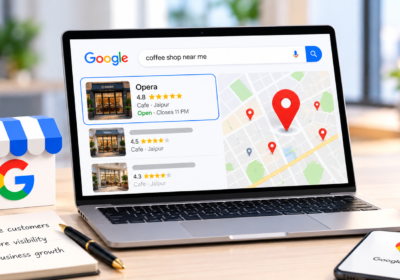
Google Maps Ranking Factors in 2026: What Actually Moves the Needle

Your competitor opened six months ago. Their business is newer, their website is basic, and you have been serving customers in this area for years. Yet they show up above you on Google Maps every single time.
It feels unfair. But it is not random.
Google Maps rankings follow a defined set of signals – and most local business owners have no idea what those signals are, let alone whether their profile is sending the right ones. This guide breaks down every Google Maps ranking factor that matters in 2026, what has changed recently, and where to focus your effort first.
The Three Pillars Google Uses to Rank Every Business
Before getting into the specifics, you need to understand the framework. Every Google Maps ranking decision runs through three core factors: Relevance, Distance, and Prominence.
Relevance measures how closely your Google Business Profile matches what the person is searching for. If someone searches “emergency dentist Manchester” and your profile does not clearly signal that you are a dentist in Manchester offering emergency appointments, you will not rank – regardless of how many reviews you have.
Distance is how close your business is to the person conducting the search. Google factors in the searcher’s location at the time of the query, not just the general area they typed.
Prominence reflects how well-established and trusted your business appears across the web. Reviews, citations, website authority, and how actively you maintain your profile all feed into this.
These three pillars have existed for years. What has changed in 2026 is the weight placed on certain sub-signals within each one, particularly as Google’s AI systems have become better at reading genuine business activity versus optimised-but-hollow profiles.
Relevance – Are You Telling Google Exactly What You Do?
Your Primary Category Is the Strongest Single Ranking Signal
Your primary GBP category is the most impactful choice you will make on your entire profile. It tells Google what type of business you are and determines which searches you are even eligible to appear for in local search results. Choosing a broad or slightly-off category can lock you out of the searches that matter most, regardless of how well-optimised everything else is.
Choose the most specific, accurate category available. If you are a personal injury law firm, do not select “Law Firm” as your primary category when “Personal Injury Attorney” exists. Secondary categories add supporting local SEO relevance signals – you can use up to ten, but only add categories for services you genuinely provide.
Services, Descriptions, and Keywords
The Services section of your GBP is a direct relevance input that most business owners leave underdeveloped. Each service should have a clear name and a description that naturally includes how customers would search for it – including location terms where relevant.
Your business description is not a place for keyword stuffing. Write it for the customer first. But make sure your core service and location appear naturally. Keywords placed across your categories, services, descriptions, posts, and review responses all contribute to local search ranking without triggering Google’s spam filters.
Profile Completeness
An incomplete profile sends an ambiguous signal to Google and a poor one to potential customers. Every field you leave blank is an opportunity handed to a competitor. Hours, attributes, services, products, Q&A – all of it matters. Businesses with complete, fully-filled profiles consistently outrank those with thin or partially-completed listings in the local pack.
Profile completeness is one of the most common and most fixable problems identified in a GBP audit.
Distance – The Factor You Cannot Fully Control (But Can Work With)
Proximity is powerful, but it is not fully within your control. Your registered address acts as the anchor for all distance calculations. Google uses it to determine how far you are from the person searching.
What catches many business owners off guard is that your Google Maps ranking is not static. A restaurant can rank first for someone two blocks away and drop significantly for someone on the other side of town. This is why a business can feel like it ranks well but still be invisible to large portions of its potential customer base.
For businesses that serve customers at the customer’s location – plumbers, cleaners, mobile pet groomers – you can set a service area in your GBP rather than a physical address. Service areas extend your geographic eligibility, but a verified physical location generally provides a stronger proximity signal than a service area alone.
Practical tip: For service-area businesses, create location-specific pages on your website targeting the cities and neighbourhoods you serve. This gives Google additional local SEO signals that you genuinely operate in those areas.
Prominence – The Factor That Separates the Top Three From Everyone Else
Prominence is where the most controllable ranking work happens. This is the pillar that rewards consistent, ongoing effort – and punishes businesses that set up their profile once and forget about it.
Reviews: Volume, Recency, and Velocity
Reviews are the dominant prominence signal in Google Maps ranking factors. But in 2026, how you accumulate reviews matters as much as how many you have. Three sub-factors drive review impact:
- Volume signals that your business has meaningful customer interaction history. More reviews generally help, but volume alone is not enough.
- Recency is increasingly important. A business with 200 reviews from three years ago can lose ground to a competitor with 80 fresh reviews from the past six months.
- Velocity – the rate at which you receive new reviews – may be the most underrated factor. Getting two new reviews every month consistently is far more valuable than getting twenty in one push and then going quiet.
A note on review keywords: customers who mention your service and location naturally in their reviews provide additional local search relevance signals. You cannot script this, but you can make sure your review generation process encourages detailed responses.
Citations and NAP Consistency
A citation is any mention of your business – name, address, and phone number – on an external website, directory, or platform. Google uses citations to cross-reference and validate your business information.
The problem is inconsistency. If your business name appears slightly differently across Google, Yelp, TripAdvisor, your local chamber of commerce directory, and other listings, those mismatches quietly undermine your credibility with Google’s systems. NAP consistency across all platforms is a foundational local SEO signal that many businesses overlook entirely.
Website Authority and Local Backlinks
Your linked website contributes to your prominence score. A website with genuine authority – particularly from locally relevant sources like local press coverage, industry associations, or community organisations – carries significant weight in local search rankings.
A handful of high-quality, locally relevant links from credible sources will outperform a large volume of low-quality directory submissions.
GBP Posts and Ongoing Activity
Your Google Business Profile has a Posts feature that most businesses either use inconsistently or ignore entirely. Posting regularly signals to Google that your business is active and operational – one of the clearest indicators of a well-managed profile versus a dormant listing.
Regular posts also increase engagement. Customers who find your listing in the local pack may interact with your posts, which feeds behavioural signals back into the ranking system.
Need help managing your profile consistently? See our GBP Management service.
What Has Changed in 2026: AI and Behavioural Signals
The most significant shift in Google Maps ranking factors over the past year is the growing influence of AI-driven analysis and behavioural signals.
Google now uses AI to analyse user behaviour, content freshness, and trust signals across the web. This means Google is not just reading your profile – it is watching what happens when people find it. Do they click through? Do they call? Do they ask for directions? Do they visit your website and stay, or bounce immediately?
These behavioural signals – clicks, calls, direction requests, time spent on your profile, website engagement after clicking from Maps – are increasingly factored into how Google perceives the quality and relevance of your listing in local search results.
The practical implication: a well-optimised profile that customers actually engage with will outperform a technically-correct but uninviting one. Your photos, your business description, your review responses, your posts – all of it contributes to whether customers take action when they find you.
There is also an emerging layer worth being aware of: AI platforms like ChatGPT, Perplexity, and Google’s own Gemini are increasingly citing local businesses in their responses. Businesses with strong, consistent information across the web are better positioned to appear in these AI-generated answers – a new channel of local search discovery that is only going to grow.
Where to Start: A Practical Priority Order
If you are not sure where to begin, work through this list in order. Each item addresses a specific Google Maps ranking factor and is entirely within your control.
- Confirm your primary GBP category is the most specific and accurate option available.
- Complete every field in your profile: hours, attributes, services, products, Q&A. Leave nothing blank.
- Build a review velocity strategy – a consistent, policy-compliant process for encouraging new reviews from satisfied customers every month.
- Respond to every review, positive and negative. Response activity signals engagement to Google and builds trust with potential customers.
- Audit your NAP consistency across Google, Yelp, Facebook, local directories, and any other platforms where your business is listed.
- Post to your GBP at least twice a month – updates, offers, news, or tips relevant to your business.
- Review your linked website for speed, mobile usability, and location-relevant content that supports your local search ranking.
Not sure which of these applies to your profile? Our free GBP optimisation audit identifies exactly where the gaps are.
The Bottom Line
Google Maps ranking factors are not a mystery – but they do require consistent, active management across multiple signals simultaneously. The businesses that dominate the local pack in 2026 are not necessarily the oldest or the most established. They are the ones whose Google Business Profiles are complete, accurate, actively maintained, and supported by a steady stream of genuine reviews and real customer engagement.
Most businesses are leaving significant local search ranking signals unaddressed simply because they do not know where to look.
Not sure where your profile stands? Get a free GBP audit – we will identify exactly what is holding your profile back and give you a clear action plan, no commitment required.
Frequently Asked Questions
What is the most important Google Maps ranking factor?
Your primary GBP category is widely considered the strongest single relevance signal – it determines which local searches you are eligible to appear for. Beyond that, review velocity and proximity to the searcher are the most impactful day-to-day factors.
Does adding keywords to my business name help rankings?
No – and it can get your profile suspended. Adding keywords or location terms to your business name field violates Google’s guidelines unless those words are genuinely part of your real-world trading name. Your GBP business name must match exactly what appears on your signage and official business registration.
Can I rank on Google Maps without a physical address?
Yes. Service-area businesses can hide their address and still rank in local results. However, a verified physical location generally provides a stronger proximity signal. If you serve customers at their location, configure your service areas carefully to reflect where you actually operate.
How many reviews do I need to rank in the local pack?
There is no fixed number. Audit the top three results in your category and use their review counts as your reference point – then focus on consistency rather than chasing a number.
How often should I post on my Google Business Profile?
A minimum of twice per month is a practical baseline. Consistency matters more than volume – regular posting on a predictable cadence is more effective than occasional bursts followed by months of silence.
Does my website affect my Google Maps ranking?
Yes, meaningfully. Your linked website’s authority, relevance, and technical quality all contribute to your prominence score. A fast, mobile-friendly website with location-relevant content that earns legitimate local backlinks will support your Maps ranking.
Why does my ranking change depending on where I search from?
Because distance is a core ranking factor calculated dynamically based on the searcher’s location at the time of the query. Your ranking is not a fixed position – it varies based on where each potential customer is when they search. This is normal behaviour for Google Maps.

About the Author
SparkLocal HQ Team
The SparkLocal HQ team helps local businesses across the US, UK and beyond get found on Google. We specialise in Google Business Profile management, reinstatement, and local SEO that drives real calls and customers.
Was this article helpful?
Keep Reading
Related Articles
Need help with your Google Business Profile?
Free audit — we'll find exactly what's holding your profile back.