

How to Improve Google Business Profile Visibility in 2026
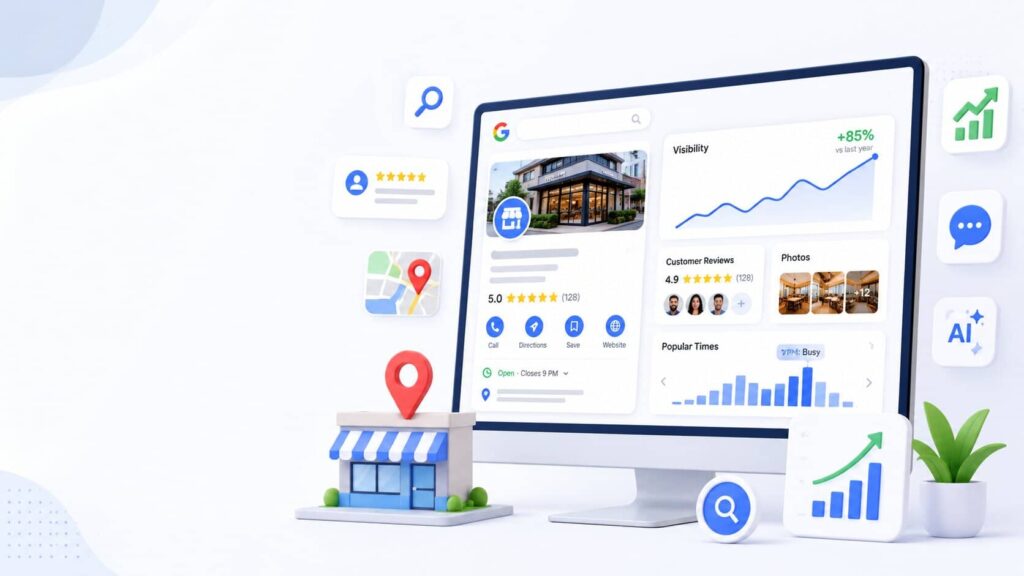
If you’ve made every “recommended” tweak to your Google Business Profile and your map pack ranking still hasn’t budged, you’re not imagining it. 2026 has been a genuinely different year for local search. Google’s 2025 spam cleanup filtered out a lot of the profiles that used to win on shortcuts, sponsored placements are now being tested inside the map pack itself, and Google’s AI systems are reading your entire online presence – not just the fields you filled out – before deciding where you rank.
The good news: the fundamentals haven’t changed. Google still ranks local businesses on relevance, distance, and prominence. What’s changed is how much deeper Google now looks to measure them. This guide walks through exactly what matters in 2026 and what to do about it, in order of impact.
How Google Ranks Business Profiles in 2026
Google’s own Business Profile documentation is still refreshingly direct about this: local ranking comes down to three factors.
- Relevance – how well your profile matches what someone is searching for
- Distance – how close your business (or service area) is to the searcher
- Prominence – how well-known and trusted your business is, both online and off
Distance is the one factor you genuinely can’t influence – you can’t move your business closer to every searcher. That means the entire game in 2026 is maximizing relevance and prominence, the two levers fully within your control.
What’s different this year is how Google measures those two factors. Instead of just checking whether fields are filled in, Google’s AI now evaluates the quality of your entire local footprint together: your profile, your reviews, your website, and how real people interact with all three. Relevance now factors in user interaction patterns and content freshness; distance considers service-area accuracy and verification quality; prominence weighs recent reviews and engagement more heavily than it used to.
There’s also a newer concept worth knowing: signal fit. Research based on an analysis of 8.7 million Google Business Profiles found that visibility isn’t governed by one universal formula – it depends on how closely your profile matches what searchers in your specific industry expect. A dental practice and a burger joint aren’t competing on the same signals in the same proportions.
One more shift to have on your radar: Google has been testing sponsored placements inside the map pack. Organic optimization is still the highest-leverage work you can do, but “visibility” in 2026 increasingly means competing against paid listings too, not just other organic profiles.
Step 1: Get the Foundation Right (Relevance)
Before touching reviews or posts, make sure the profile itself is telling Google exactly what your business does and where.
- Choose your primary category with precision. This remains the single biggest relevance lever in your control. Don’t default to a broad category because it feels safer – the most specific accurate category almost always outperforms a generic one.
- Add secondary categories, but don’t stuff them. List categories that genuinely describe services you offer. Irrelevant categories dilute relevance rather than expanding it.
- Fill in every field completely. Services, attributes, business description, hours (including holiday hours), and service areas all feed directly into how Google matches you to searches.
- Keep your NAP (Name, Address, Phone) identical everywhere. Your website, citations, and profile need to match exactly.
- Be careful with keyword-stuffed business names. Some profiles still rank well partly because their business name contains a service keyword. It works, but it’s risky – Google can verify your legal business name and suspend or force reverification of profiles that add keywords that aren’t part of the real name. The safer route is registering a proper DBA (doing business as) or trade name through your state or county.
Step 2: Build Prominence Through Reviews
Reviews remain one of the strongest prominence signals Google has – but the rules around what counts have gotten more specific.
- Quality and recency beat raw volume. Google’s systems now weigh review sentiment, keyword relevance, freshness, and reviewer authority, alongside how consistently new reviews come in.
- Consistency beats bursts. A steady drip of new reviews performs better long-term than one big push followed by silence. There’s some evidence of an early visibility boost once a profile reaches around ten reviews – but that’s a starting line, not a finish line.
- Respond to every review – yes, even the good ones. Owner responses are a genuine trust and engagement signal, and Google rewards replies that are timely, specific, and personalized over generic copy-paste responses.
- Have a plan for negative reviews. Respond professionally and move detailed disputes offline. Consumer expectations have risen sharply – 68% of consumers now only consider businesses rated 4 stars or higher, up from 55% the year before.
- Know that reviews can disappear. Google’s moderation systems, industry-specific risk flags, and geography all affect which reviews stay visible over time. Keep review generation an ongoing habit rather than a one-time push.
Step 3: Turn On Engagement Signals
Google increasingly treats real user behavior as proof that your business deserves to rank – not just what’s written on the profile. Specifically, Google tracks:
- Profile views
- Website clicks
- Phone calls
- Direction requests
- Message response time
- Photo views
Google Business Messaging is now a direct ranking factor. Businesses that respond to messages within an hour see measurably better local visibility. If messaging is currently an afterthought, this is one of the highest-ROI fixes available in 2026 – set up notifications and treat response time like you would a missed call.
Give people a reason to click, call, or ask for directions. Clear calls-to-action, accurate booking links, and current offers all increase the engagement Google is watching. Profiles that actively manage every available feature see substantially more profile views and website clicks than bare-bones listings.
Step 4: Keep Visual Content Fresh
Photos and video aren’t just decoration – they’re an engagement driver Google can measure.
- Upload real, recent photos: your storefront, team, products, and services in action
- Avoid stock photography – authenticity outperforms polish
- If you use video, keep it to 1080p resolution, under 100MB, and add captions for accessibility
- Encourage (and monitor) customer-uploaded photos, which carry their own authenticity signal
Profiles with a steady stream of authentic visual content tend to see more interactions – and more interactions feed straight back into the prominence signals covered above.
Step 5: Post Regularly to Signal Freshness
Google Posts are an underused lever. A profile that hasn’t posted in six months looks stale to an algorithm that now explicitly rewards content freshness as part of relevance.
- Aim for weekly posts – offers, updates, events, new products or services
- Let post content naturally reflect the keywords and services you actually want to rank for, without forcing it
- Use posts to reinforce anything time-sensitive: seasonal hours, promotions, new locations
This is low-effort compared to review generation or website work, and it’s one of the more direct freshness signals you can control on a weekly basis.
Step 6: Strengthen Website & Off-Profile Authority
Your Google Business Profile doesn’t exist in isolation – Google is increasingly evaluating it alongside your website and citation footprint as one connected system.
- Make sure your linked website is fast and mobile-optimized. A slow or clunky site undercuts the trust your profile is trying to build.
- Add local SEO fundamentals on-site: schema markup, location-specific pages if you serve multiple areas, and NAP details that match your profile exactly.
- Prioritize citation consistency over citation volume. A handful of accurate listings on high-authority, relevant directories now outperforms mass submissions to low-quality directories.
- Earn backlinks from local and industry-relevant sites. These reinforce prominence and help validate your business as a genuine local entity.
Step 7: Get Service Area & Proximity Details Right
You can’t control distance, but you can make sure Google has accurate information to work with.
- If you’re a service-area business without a public storefront, set your service areas precisely rather than casting an unnecessarily wide net
- Keep your verified location accurate – Google doesn’t always update where it thinks your business is located just because you change an address, so confirm this after any move
- Avoid listing service areas you don’t genuinely cover; it dilutes relevance rather than expanding reach
Common Mistakes That Hold Profiles Back
- Keyword-stuffing the business name without a legitimate DBA – a fast path to suspension after Google’s 2025 enforcement tightened
- Inconsistent NAP across your website, citations, and profile
- Ignoring negative reviews instead of responding professionally
- Letting the profile go stale – no new posts or photos for months at a time
- Duplicate or unverified listings competing against your main profile
- Treating messaging as optional when it’s now a direct ranking factor
- Chasing generic tactics instead of the signals that matter most for your specific industry
Quick-Reference Checklist
- Primary category is the most specific accurate option available
- All profile fields completed (services, attributes, description, hours, service areas)
- NAP matches exactly across website, citations, and profile
- Review requests sent consistently, not in bursts
- Every review – positive and negative – gets a timely, personalized response
- Messages answered within one hour
- Fresh, authentic photos added regularly; video meets spec (1080p, <100MB, captioned)
- At least one Google Post published weekly
- Website is fast, mobile-optimized, and uses local schema
- Citations are accurate and consistent, prioritizing quality over quantity
- Service areas and verified location are accurate and up to date
FAQ
Do reviews still matter for Google Business Profile ranking in 2026?
Yes – but quality, freshness, and consistency now matter more than sheer volume. Google evaluates sentiment, keyword relevance, reviewer authority, and how often you respond.
How often should I post on Google Business Profile?
Weekly is a reasonable baseline. Content freshness is now an explicit part of how Google measures relevance.
Does responding to Google Business messages actually affect ranking?
Yes. Google Business Messaging became a ranking factor in late 2025, and businesses that respond within an hour see improved local visibility.
How many reviews do I need to rank well?
There’s no fixed number, but profiles tend to see early visibility momentum around ten reviews. Long-term ranking depends more on ongoing, steady review growth than hitting a specific total.
Can I influence proximity/distance ranking?
Not directly – distance is based on the searcher’s location relative to your business or service area. You can, however, make sure your verified location and service areas are accurate, which prevents Google from working off outdated or incorrect data.
The Bottom Line
There’s no single hack that moves a Google Business Profile into the map pack in 2026. The businesses winning right now are the ones treating their profile, reviews, engagement, and website as one connected system – and improving all four consistently, month over month. Distance will always be outside your control. Relevance and prominence aren’t, and that’s where the real work – and the real opportunity – lives.
Need help auditing your Google Business Profile against these 2026 factors? Reach out to the Spark Local HQ team for a full local SEO review.

About the Author
SparkLocal HQ Team
The SparkLocal HQ team helps local businesses across the US, UK and beyond get found on Google. We specialise in Google Business Profile management, reinstatement, and local SEO that drives real calls and customers.
Was this article helpful?
Keep Reading
Related Articles
Need help with your Google Business Profile?
Free audit — we'll find exactly what's holding your profile back.